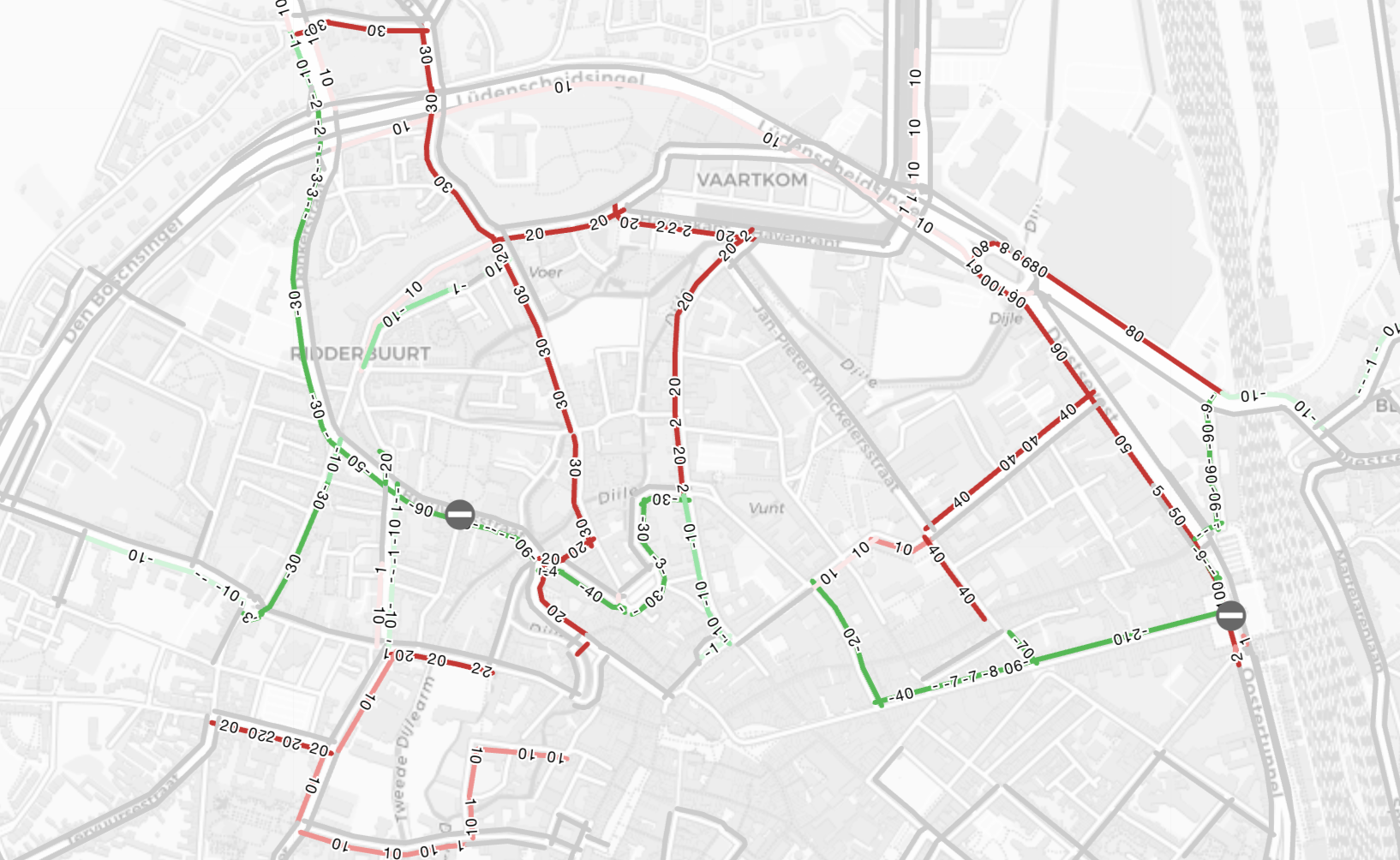
Insight into traffic in just a few clicks
Traffic is constantly changing. A new school, roadworks, a traffic filter, or a lower speed limit: how do they affect traffic flow in a neighbourhood or municipality? Traffic Scout helps you make that impact visible straight away.
In just fifteen minutes, you can use Traffic Scout to simulate the effects of a measure. No complex models or heavy software: this user-friendly web tool is specially designed for mobility officers, consultants, and traffic experts.
See whether the new connection will attract rat-running traffic or rather divert cars away from residential streets.
Simulate what happens when you go from 70 km/h to 50 km/h. Do drivers change their routes? Does traffic pressure decrease?
Test temporary diversions and discover where bottlenecks might appear.
See how traffic redistributes itself when you apply a circulation measure. Will cars disappear from the street, or find new shortcuts?
Check how this affects traffic levels in the wider area and whether new rat-runs might appear through neighbourhoods.
Compare different scenarios at a glance: where does traffic flow smoothly, and where will it become busier?
Benefits
Insights into local mobility
Traffic Scout provides insights into traffic volumes at a local level in a simple, user-friendly way.
A diversion, a reversal of driving direction, a new parking regime: the traffic model can show the impact before and after the intervention.
Intelligent & high-quality
The technology is built upon Telraam data, census data, traffic indicators, geodata and OpenStreetMap, among others. A reliable set of source data is carefully monitored and periodically updated to match the required applications. Multiple iterations ensure a qualitative approach.
Easy to use
Traffic Scout has been designed specifically for the local mobility officer with the aim of providing a simple, user-friendly application that supports the implementation of local mobility policy in a qualitative manner. Thanks to training and tools, the application can be deployed quickly.
Process
1. Collect data
A traffic model requires high quality and reliable data. We use our own sources but also aggregate specific local information.
2. Feedback
Any necessary rounds of calibration are carried out within a clearly defined timeframe with minimal effort for the client.
3. Create scenario
After refining the input, a reference scenario, which serves as a basis for comparisons can be created.
4. Analysis
In this final step, the model is ready for use and the impact of traffic interventions can easily be tested.